
There is something strange about modern life. We have more access to information than any generation before us, yet I am not sure we are seeing more clearly. Much of the time, it feels like the opposite. We wake up and immediately enter a stream of people telling us what happened, what matters, what we should be worried about, who we should be angry with, what we should buy, what we should fear, and what we are apparently supposed to have an opinion about before breakfast.
After a while, I started asking a different question. Not whether the latest thing was important, but whether it was important to me. That is a very different question, and once I began asking it, I started noticing how much of my attention had been given away without me ever consciously deciding to give it.
About The Visual Intervention
Beyond the Noise
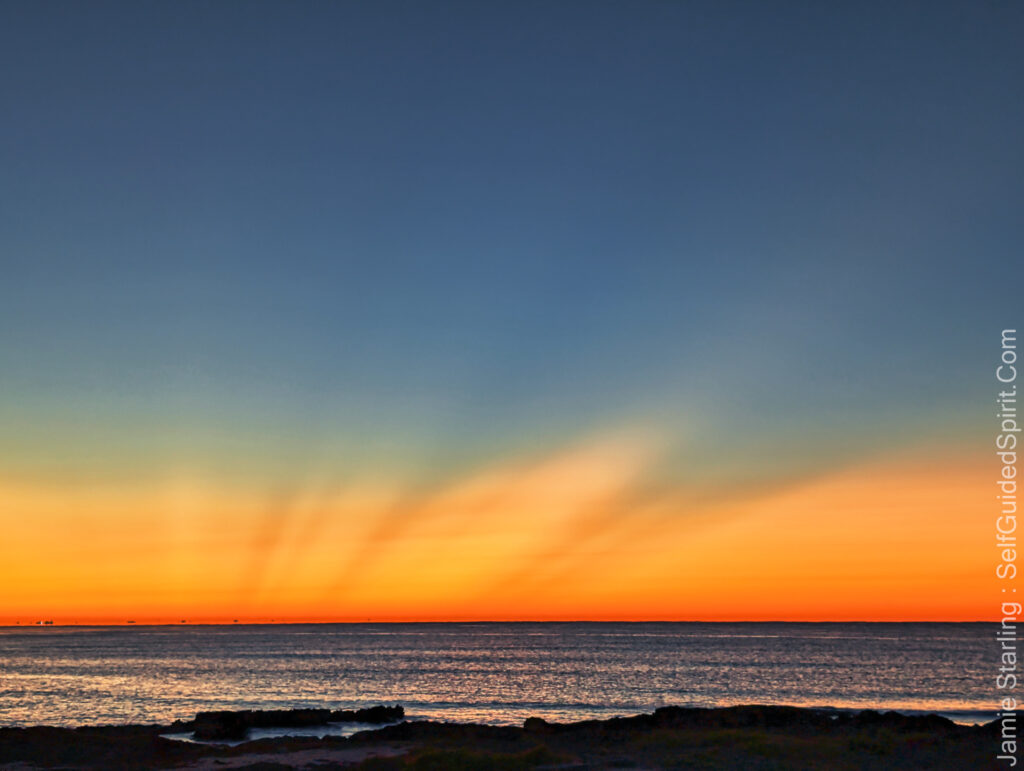
Received : February 2, 2026 - Paamul, Mexico.
A sunset does not ask you to agree with it. It does not need you to click anything, defend anything, buy anything, or become angry at someone you have never met. It simply appears, and for a few moments there is nothing to do but see it.
That is part of why I share photographs like this. They are not meant to explain anything. They are a small interruption in the other direction. A pause in a world that seems determined to keep us stimulated, worried, and reacting.
Who Decided What Deserves Your Attention?
Most of us think of attention as something passive. We notice whatever happens to be in front of us. But attention is not passive. What receives our attention receives a portion of our life. It receives our time, our thought, our emotional energy, and often our behavior afterward.
That makes the question of attention much larger than whether we spend too much time on our phones. The deeper question is who, or what, is deciding what gets access to us.
Politics wants our attention. Advertising wants it. Social media wants it. News organizations want it. Entertainment wants it. Businesses want it. Causes want it. Other people want it. Much of this is normal. Everyone has something they want us to notice. The problem begins when we stop choosing and simply allow the loudest thing in the room to decide for us.
Then our life becomes reactive. Something happens somewhere in the world and, within minutes, thousands or millions of people who were not involved are emotionally pulled into it. We become angry. We argue. We defend positions. We spend hours reading comments written by people we do not know. Sometimes we go to bed carrying the emotional weight of events that have almost nothing to do with the life directly in front of us.
I began to notice the cost of that in myself. It was not simply lost time. It changed the quality of the time that remained. Even after I put the phone down or stopped reading, some part of the argument came with me. My body was still carrying it. My mind was still working on it. Something I had given ten minutes of attention could occupy another hour without permission.
The Argument That Never Ends
Social media makes this especially visible. It is very easy to spend an evening arguing with someone we have never met, trying to make them understand that we are right. I have done it. Most of us probably have.
But at some point I began wondering what exactly I was accomplishing. Whether the person on the other side was a real person, a bot, someone deliberately provoking people, or simply another human being as convinced of their position as I was almost did not matter. The result was the same. I had given part of my evening to an argument that changed nothing and left me with less energy for the life that was actually mine.
That word engagement is interesting. Online platforms want engagement. Advertisers want engagement. Content creators want engagement. It sounds harmless enough. But engagement is another word for attention, and attention is paid for with pieces of our lives.
The payment is small enough that we rarely notice it. Five minutes here. Ten minutes there. A headline. A comment. Another video. One more response. But a life is made of small pieces of time. There is no separate warehouse somewhere holding the important hours for us while we spend the unimportant ones.
Being Sober at the Party
The closest comparison I can make is going to a party and deciding not to drink. Everyone around you is drinking, laughing louder as the evening goes on, repeating themselves, getting into arguments that seem incredibly important to them at the time. If you are sober, eventually the whole thing begins to look a little strange.
The strange part is that the people drinking may think you are the strange one. Why are you not joining in? Why are you not as excited about this as everyone else? Why are you standing over there watching instead of participating?
I think stepping away from the constant stream of news, politics, outrage, trends, and online arguments can feel exactly like that. At first there is a sense that you must be missing something. Everyone else seems deeply involved. Something important must be happening if everyone is talking about it.
Then, after some time away, you begin seeing the intoxication itself.
Not because you have become better than anyone else. That would simply be another trap. You see it because you are no longer inside it every moment. The distance gives you enough room to notice what the constant stimulation was doing to you.
The Choice I Made
For me, part of reclaiming my attention meant making a conscious choice not to participate in politics and not to continually follow the news. I did not make that choice because nothing happening in the world matters. I made it because I had to become more honest about what I could actually affect and what all of that information was doing inside me.
Knowing about every terrible thing that happened did not make me more useful. Being angry about things I could not change did not make me more responsible. Carrying fear from one headline into the next did not improve the small part of the world that had actually been placed in front of me.
There are things I can touch. There are people I can help. There is work I can make. There are photographs I can receive. There are conversations I can have. There is a home I can care for and a life I can actually live. When I pour all of my energy into events far beyond my reach, there is less of me left for those things.
This is not an argument for ignorance. It is an argument for choice.
I want to know why I am giving something my attention before I give it away. I want to know whether it helps me see more clearly or simply keeps me agitated. I want to know whether I am responding because something truly matters to me or because someone else has become very good at making it feel urgent.
A Small Act of Rebellion
I still engage online, but I try to do it with more awareness. Often that means sharing a photograph. Something quiet. A sunrise, a sunset, water, light, a moment that stopped me long enough to notice it.
I have come to think of that as a small act of rebellion. Not rebellion in the sense of fighting anything, but simply refusing to add more noise. The world already has enough people telling us what to fear and who to hate. I do not need to contribute another serving.
A photograph cannot force anyone to slow down. It cannot make someone peaceful. It cannot rescue someone from the machinery of distraction. But it can offer another possibility for a moment. Here is some light on the water. Here is a sky changing color. Here is something that does not need anything from you.
The person looking at it can stop or keep scrolling. That part belongs to them.
Maybe that is all any of us can really offer one another: something different, then the freedom to choose.
What Truly Matters
The hardest part of reclaiming our attention may not be turning off notifications or spending less time online. Those things help, but the deeper work is deciding what deserves our attention once we have it back.
That is a much more personal question. No algorithm can answer it for us. No news organization can answer it. No political party, religion, influencer, company, or spiritual authority can tell us what the center of our own life should be. They can make suggestions. They can make demands. They can tell us what they believe should matter.
But we still have to choose.
Maybe what matters is your family. Maybe it is the work you have been putting off. Maybe it is creating something. Maybe it is sitting outside for twenty minutes without needing to be entertained. Maybe it is repairing a relationship, walking in the woods, building a model, making dinner, taking a photograph, or simply noticing that the person sitting across from you has been trying to talk while half of your mind is somewhere else.
None of those things will arrive with a breaking-news banner. They will not vibrate in your pocket. They will not fight very hard for your attention.
That may be exactly why we have to choose them deliberately.
I do not think freedom means shutting out the world. I think it means becoming conscious enough that the world does not get to decide, moment by moment, what will occupy our minds. We can look. We can listen. We can participate when participation is ours to give. But we can also say no. We can leave some things untouched. We can allow an argument to continue without us.
Our attention is not an endless resource. It is the substance our days are made from. Where we place it, repeatedly, becomes the life we eventually discover we have been living.
A Question to Sit With
What is asking for your attention right now that has never earned the right to have it?