There is something strange about modern life. We have more access to information than any generation before us, yet I am not sure we are seeing more clearly. Much of the time, it feels like the opposite. We wake up and immediately enter a stream of people telling us what happened, what matters, what we should be worried about, who we should be angry with, what we should buy, what we should fear, and what we are apparently supposed to have an opinion about before breakfast.
After a while, I started asking a different question. Not whether the latest thing was important, but whether it was important to me. That is a very different question, and once I began asking it, I started noticing how much of my attention had been given away without me ever consciously deciding to give it.
About The Visual Intervention
Beyond the Noise
Received : February 2, 2026 - Paamul, Mexico.
A sunset does not ask you to agree with it. It does not need you to click anything, defend anything, buy anything, or become angry at someone you have never met. It simply appears, and for a few moments there is nothing to do but see it.
That is part of why I share photographs like this. They are not meant to explain anything. They are a small interruption in the other direction. A pause in a world that seems determined to keep us stimulated, worried, and reacting.
Who Decided What Deserves Your Attention?
Most of us think of attention as something passive. We notice whatever happens to be in front of us. But attention is not passive. What receives our attention receives a portion of our life. It receives our time, our thought, our emotional energy, and often our behavior afterward.
That makes the question of attention much larger than whether we spend too much time on our phones. The deeper question is who, or what, is deciding what gets access to us.
Politics wants our attention. Advertising wants it. Social media wants it. News organizations want it. Entertainment wants it. Businesses want it. Causes want it. Other people want it. Much of this is normal. Everyone has something they want us to notice. The problem begins when we stop choosing and simply allow the loudest thing in the room to decide for us.
Then our life becomes reactive. Something happens somewhere in the world and, within minutes, thousands or millions of people who were not involved are emotionally pulled into it. We become angry. We argue. We defend positions. We spend hours reading comments written by people we do not know. Sometimes we go to bed carrying the emotional weight of events that have almost nothing to do with the life directly in front of us.
I began to notice the cost of that in myself. It was not simply lost time. It changed the quality of the time that remained. Even after I put the phone down or stopped reading, some part of the argument came with me. My body was still carrying it. My mind was still working on it. Something I had given ten minutes of attention could occupy another hour without permission.
The Argument That Never Ends
Social media makes this especially visible. It is very easy to spend an evening arguing with someone we have never met, trying to make them understand that we are right. I have done it. Most of us probably have.
But at some point I began wondering what exactly I was accomplishing. Whether the person on the other side was a real person, a bot, someone deliberately provoking people, or simply another human being as convinced of their position as I was almost did not matter. The result was the same. I had given part of my evening to an argument that changed nothing and left me with less energy for the life that was actually mine.
That word engagement is interesting. Online platforms want engagement. Advertisers want engagement. Content creators want engagement. It sounds harmless enough. But engagement is another word for attention, and attention is paid for with pieces of our lives.
The payment is small enough that we rarely notice it. Five minutes here. Ten minutes there. A headline. A comment. Another video. One more response. But a life is made of small pieces of time. There is no separate warehouse somewhere holding the important hours for us while we spend the unimportant ones.
Being Sober at the Party
The closest comparison I can make is going to a party and deciding not to drink. Everyone around you is drinking, laughing louder as the evening goes on, repeating themselves, getting into arguments that seem incredibly important to them at the time. If you are sober, eventually the whole thing begins to look a little strange.
The strange part is that the people drinking may think you are the strange one. Why are you not joining in? Why are you not as excited about this as everyone else? Why are you standing over there watching instead of participating?
I think stepping away from the constant stream of news, politics, outrage, trends, and online arguments can feel exactly like that. At first there is a sense that you must be missing something. Everyone else seems deeply involved. Something important must be happening if everyone is talking about it.
Then, after some time away, you begin seeing the intoxication itself.
Not because you have become better than anyone else. That would simply be another trap. You see it because you are no longer inside it every moment. The distance gives you enough room to notice what the constant stimulation was doing to you.
The Choice I Made
For me, part of reclaiming my attention meant making a conscious choice not to participate in politics and not to continually follow the news. I did not make that choice because nothing happening in the world matters. I made it because I had to become more honest about what I could actually affect and what all of that information was doing inside me.
Knowing about every terrible thing that happened did not make me more useful. Being angry about things I could not change did not make me more responsible. Carrying fear from one headline into the next did not improve the small part of the world that had actually been placed in front of me.
There are things I can touch. There are people I can help. There is work I can make. There are photographs I can receive. There are conversations I can have. There is a home I can care for and a life I can actually live. When I pour all of my energy into events far beyond my reach, there is less of me left for those things.
This is not an argument for ignorance. It is an argument for choice.
I want to know why I am giving something my attention before I give it away. I want to know whether it helps me see more clearly or simply keeps me agitated. I want to know whether I am responding because something truly matters to me or because someone else has become very good at making it feel urgent.
A Small Act of Rebellion
I still engage online, but I try to do it with more awareness. Often that means sharing a photograph. Something quiet. A sunrise, a sunset, water, light, a moment that stopped me long enough to notice it.
I have come to think of that as a small act of rebellion. Not rebellion in the sense of fighting anything, but simply refusing to add more noise. The world already has enough people telling us what to fear and who to hate. I do not need to contribute another serving.
A photograph cannot force anyone to slow down. It cannot make someone peaceful. It cannot rescue someone from the machinery of distraction. But it can offer another possibility for a moment. Here is some light on the water. Here is a sky changing color. Here is something that does not need anything from you.
The person looking at it can stop or keep scrolling. That part belongs to them.
Maybe that is all any of us can really offer one another: something different, then the freedom to choose.
What Truly Matters
The hardest part of reclaiming our attention may not be turning off notifications or spending less time online. Those things help, but the deeper work is deciding what deserves our attention once we have it back.
That is a much more personal question. No algorithm can answer it for us. No news organization can answer it. No political party, religion, influencer, company, or spiritual authority can tell us what the center of our own life should be. They can make suggestions. They can make demands. They can tell us what they believe should matter.
But we still have to choose.
Maybe what matters is your family. Maybe it is the work you have been putting off. Maybe it is creating something. Maybe it is sitting outside for twenty minutes without needing to be entertained. Maybe it is repairing a relationship, walking in the woods, building a model, making dinner, taking a photograph, or simply noticing that the person sitting across from you has been trying to talk while half of your mind is somewhere else.
None of those things will arrive with a breaking-news banner. They will not vibrate in your pocket. They will not fight very hard for your attention.
That may be exactly why we have to choose them deliberately.
I do not think freedom means shutting out the world. I think it means becoming conscious enough that the world does not get to decide, moment by moment, what will occupy our minds. We can look. We can listen. We can participate when participation is ours to give. But we can also say no. We can leave some things untouched. We can allow an argument to continue without us.
Our attention is not an endless resource. It is the substance our days are made from. Where we place it, repeatedly, becomes the life we eventually discover we have been living.
A Question to Sit With
What is asking for your attention right now that has never earned the right to have it?
Most of us are taught to look outside ourselves for freedom.
We look for the right circumstances, the right approval, the right answer, the right permission. We imagine freedom as something that arrives once life finally gives us enough space.
But real freedom may begin in a quieter place.
It may begin when we stop asking the outside world to decide who we are allowed to be.
About The Visual Intervention
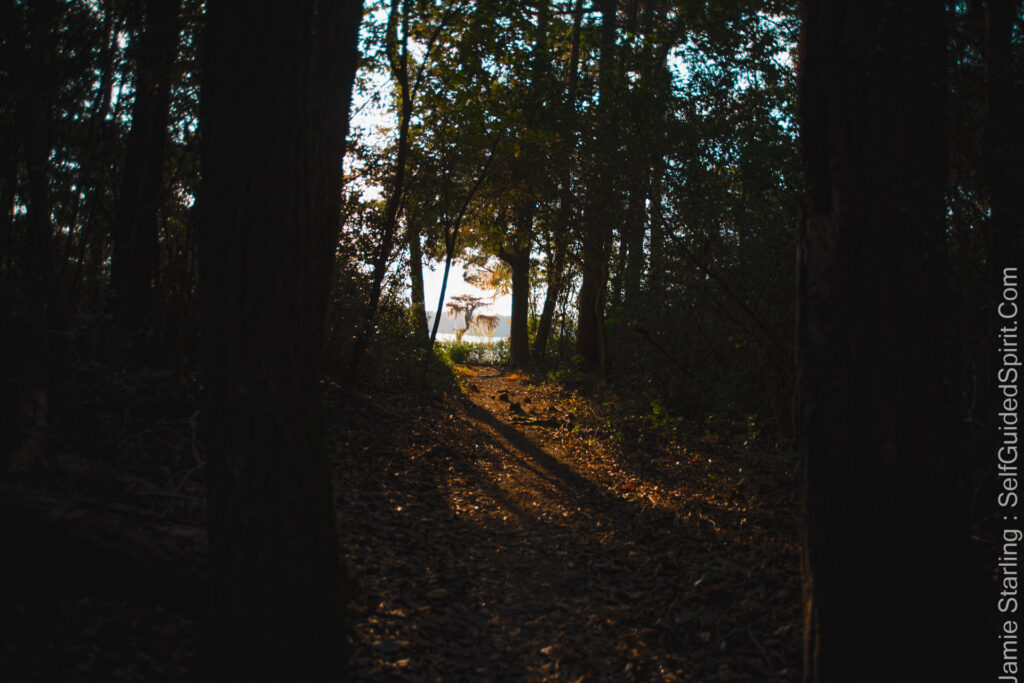
Freedom Awaits
Received : 2017 November 4 – Jones Lake, North Carolina
Just enough room to see that freedom is not always a change in location. Sometimes it is a change in relationship. To life. To fear. To the need for approval. To the old belief that someone else must open the door.
Freedom Is Not Somewhere Else
The belief that freedom comes from within changes where we look. Most of us are trained to look outward. We think we will be free when the situation changes, when people understand us, when the pressure lifts, when the past stops hurting, or when we finally have more time, more money, more certainty, and more permission.
Some of those things matter. Outer conditions are real. Pain is real. Responsibility is real. There are situations that need to be changed, left, repaired, or faced directly. Inner freedom should never be used as a way to excuse harm or avoid action. But there is another kind of captivity that does not end just because the outside world improves.
It is the captivity of living by fear. It is needing approval before you trust yourself. It is believing your peace depends entirely on what others do, say, think, or give back to you. That is where inner freedom begins — not as an idea, but as a practice of seeing clearly.
You may not control everything that happens around you. You may not control what others believe. You may not control how life unfolds. But there is still a place within you where choice remains. You can ask: How will I meet this? What is mine to carry? What am I no longer willing to hand away?
Freedom from within does not mean pretending life is easy. It does not mean smiling through pain or calling every hardship a lesson. It does not mean accepting harm, avoiding action, or becoming passive. Acceptance is not surrendering your life. It is seeing what is actually here.
When you stop fighting reality in your mind, you get some of your energy back. You can see the situation more clearly. You can decide what needs to change. You can choose where to stand firm and where to let go. That kind of acceptance is not weakness. It is contact with the truth of the moment.
Inner freedom also asks you to look at the beliefs that have been running your life quietly: the need to be liked, the fear of being judged, the habit of waiting for permission, the old story that says you are only safe when everyone approves. These things can become invisible cages. They do not always look like cages because they often feel normal. They feel like personality. They feel like being practical. They feel like keeping the peace.
But if you have to abandon yourself to keep the peace, something is wrong. Freedom begins when you notice where you have been leaving yourself behind. It begins when you stop treating your own inner knowing as something secondary.
This does not mean you never listen to others. It does not mean you become hard, closed, or untouchable. It means you stop confusing outside voices with your own center. You can receive wisdom without surrendering your authority. You can listen deeply without disappearing. You can love people without letting them define the shape of your life.
Freedom from within is not escape from responsibility. It is responsibility taken seriously. It is the decision to meet your life from awareness rather than reaction, to act from clarity rather than fear, and to let go of what is not yours while stepping more honestly into what is.
There may still be difficult choices. There may still be grief. There may still be uncertainty. But something changes when you stop waiting for the world to hand you freedom and begin recognizing the places where you have already been giving it away. The door may not open all at once, but you begin to see where your hand has been on the lock.
Where are you still asking the outside world for permission to be free?
Your attention is not free. Every time you give it away, something is being shaped in you. Not all at once. Not loudly. But slowly, through repetition.
What you watch. What you feed. What you return to. What you let interrupt your inner life. These things do not simply pass through you and disappear. They leave an imprint. They train your nervous system. They shape what feels urgent, what feels desirable, what feels normal, and what feels worth caring about.
Eventually, your attention becomes your direction.
About The Visual Intervention
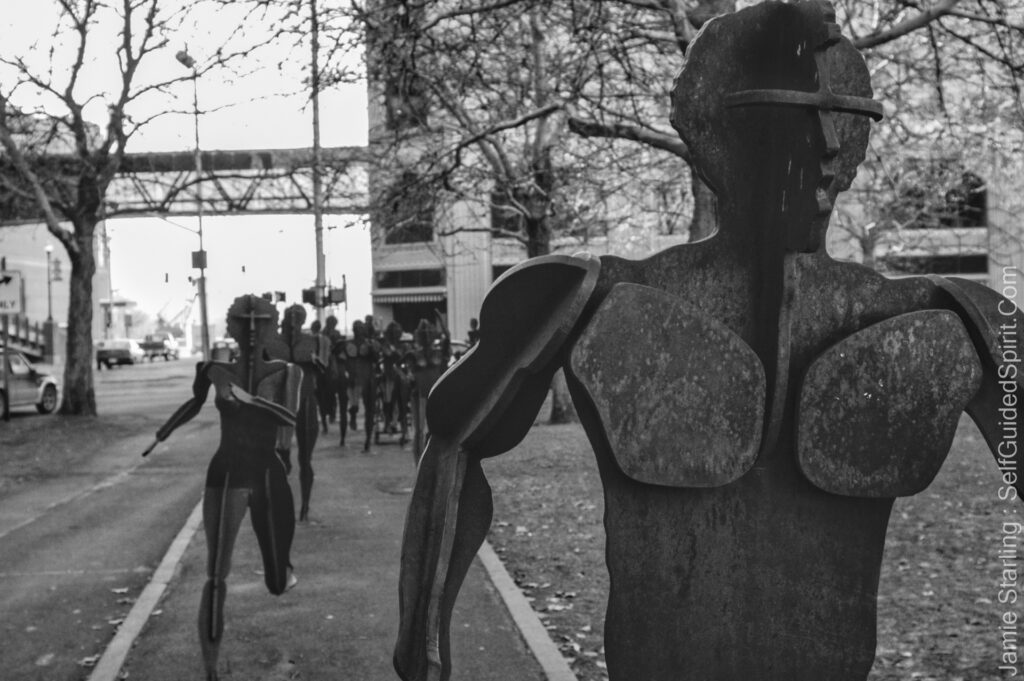
Running After
Received : 2005 February 2 – Spokane, Washington.
What has been taking too much of you?
Attention Is Where Your Life Is Being Spent
We usually talk about attention like it is a productivity issue. We say we need to focus more, scroll less, manage our time better, or stop getting distracted. There is truth in that, but it does not go deep enough.
Attention is not only about getting more done. Attention is about what is slowly becoming your life.
Where your attention goes, your energy follows. Where your energy goes, your habits form. Where your habits form, your life begins to take shape. This is why attention matters. Not because you need to become some perfectly disciplined person who never wastes a minute, but because your attention is one of the main ways you participate in your own becoming.
If you give the best of your mind to noise long enough, noise starts to feel normal. If you give your attention to comparison long enough, your own life starts to feel insufficient. If you keep feeding urgency, outrage, distraction, and stimulation, it becomes harder to hear the quieter things inside you that actually matter.
What you feed becomes louder.
The Pull of Brain Candy
And I get it. Sometimes we just want some brain candy. We want to watch a few shorts, scroll Facebook for a minute, play a game, check out, laugh at something, or let our mind go somewhere that does not ask much from us.
There is nothing wrong with needing rest. There is nothing wrong with entertainment. There is nothing wrong with enjoying something that gives the mind a break.
The problem is when a break quietly becomes a pattern, and the pattern quietly becomes a direction.
I have seen this in myself. I would watch a short or see something online and think, I am just going to look into this for a minute. Then one thing would lead to another. A video would lead to a search. A search would lead to another clip. A comment would lead to another thought. Before I knew it, an hour or more was gone.
It did not feel dramatic while it was happening. That is part of the danger. It never announced itself as a theft. It just took a little bit, then a little more, then a little more after that.
The same thing can happen with video games. I enjoy them. I am not going to pretend I do not. But there is a moment, especially with games that show you how many total hours you have played, where it starts to hit differently. You look at the number and realize that this was not just downtime. This was a piece of your life.
And then the harder question shows up: what could I have built with that same time?
The Cost Is Not Only Time
It is easy to say the cost of distraction is time, but that is only part of it. The deeper cost is energy. Direction. Inner momentum. The slow weakening of your ability to stay with something that matters.
An hour here and there may not seem like much. But attention compounds. So does avoidance. So does creation.
The time spent scrolling could have become a skill. The time spent drifting could have become a piece of writing, a photograph, a model, a project, a stronger body, a clearer mind, a better relationship with your own life. Not because every moment has to be productive, but because a life cannot be built from leftovers alone.
We all need downtime. We all need rest. We all need moments where nothing is being produced, measured, improved, or optimized. But there is a difference between rest that restores you and distraction that drains you while pretending to comfort you.
Rest gives something back.
Distraction usually asks for more.
What Owns Your Attention Owns Your Direction
This is why attention is an inner authority issue. If something can continually pull your attention, it can slowly shape your direction without your permission.
It can tell you what to care about. It can tell you what to fear. It can tell you what to compare yourself to. It can tell you what is urgent, what is desirable, what is missing, and what kind of life you should be chasing.
And if you are not paying attention to what is shaping you, you may mistake that influence for your own thoughts.
That is where the real danger is. Not the phone. Not the game. Not the app. Not the entertainment itself. The danger is unconscious surrender. The danger is giving your inner life away in small pieces and never stopping long enough to ask where it all went.
Your attention is your life, spent moment by moment.
That does not mean you need to live rigidly. It means you need to live awake.
Building Something of Your Own
At some point, we have to ask a better question than, “Is this bad?”
A better question is, “What is this building in me?”
That question changes everything. It moves the conversation away from guilt and toward responsibility. It stops making attention about rules and starts making it about direction.
What would happen if some of that energy went toward building something of your own? Not necessarily a business. Not necessarily something impressive. Maybe a model. A garden. A skill. A piece of writing. A body of work. A practice. A craft. A habit that makes your life better in the end.
Creation does something different to a person than consumption does. When you create, you participate. You make contact with your own agency. You remember that your life is not only something happening to you. It is something you are helping shape.
That is why this matters for Self Guided Spirit. It is not just about using time better. It is about returning to the part of yourself that can still choose, still notice, still build, still become.
Reclaiming Attention Without Turning It Into Performance
The answer is not to become harsh with yourself. Shame does not create freedom. It usually creates another cycle to escape from.
The answer is awareness. Start noticing what gets the best of you. Notice what you reach for when you are tired, uncertain, lonely, bored, restless, or avoiding the next honest thing. Notice what leaves you clearer and what leaves you scattered. Notice what restores you and what only numbs you.
Then make one honest adjustment.
Not a dramatic vow. Not a new identity. Not a performance of discipline. Just one choice that says: my attention matters. My energy matters. My life matters.
Put the phone down for a while. Turn the game off before the night disappears. Make the thing. Write the page. Take the walk. Pick up the camera. Practice the skill. Sit in the quiet long enough to hear what has been buried under the noise.
You do not have to reclaim your whole life in one day. But you do have to stop pretending that what you give yourself to does not shape you.
The Quiet Return
Your attention is not free. It is being spent every day, whether you choose consciously or not.
The question is not whether you will give your attention away. You will. We all do. The question is whether you are giving it to things that help you become more awake, more honest, more alive, and more responsible for your own path.
Because what owns your attention eventually influences your life. And what you keep returning to becomes part of who you are becoming.
There comes a point when waiting for permission becomes a way of abandoning yourself.
You may call it patience. You may call it timing. You may call it being responsible.
And sometimes, it really is those things.
But sometimes, underneath all of that, there is a quieter truth:
You already know what you need to do. You are just waiting for someone else to make it safe.
About The Visual Intervention
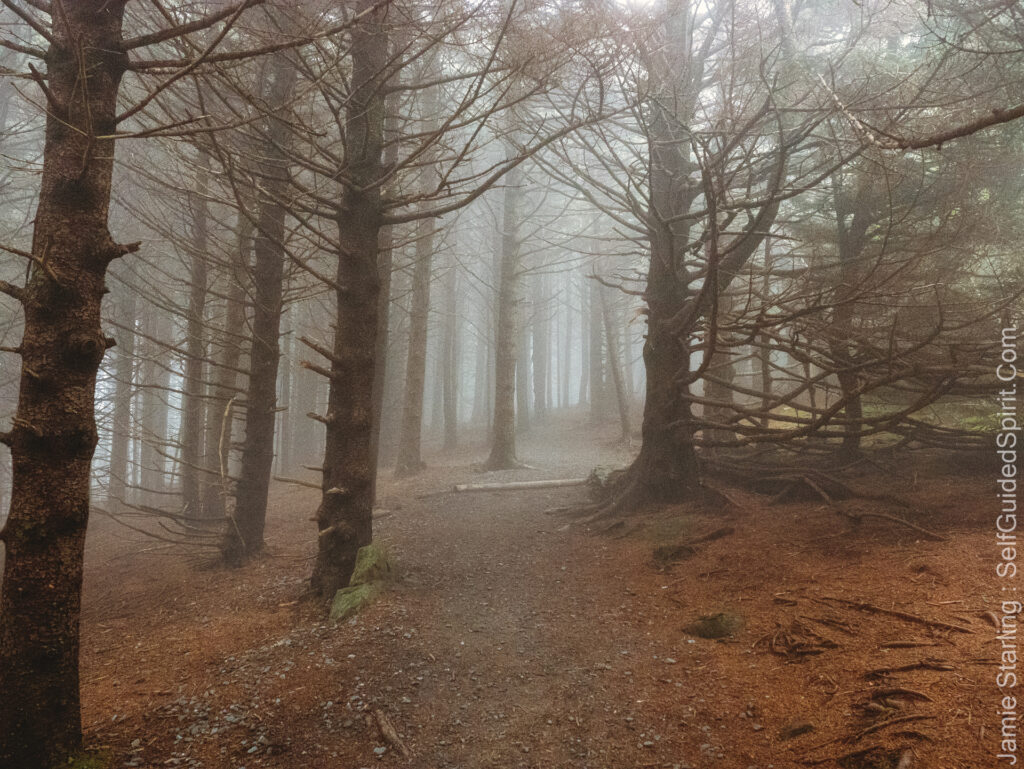
Along The Path Into The Fog
Received : 2017 June 16 – Carvers Gap, Appalachian Trail.
You are not fully stuck. You are not fully moving. You are standing in the space between knowing and choosing.
The Quiet Habit of Waiting
Most people do not announce that they are waiting for permission. They call it being practical. They call it doing more research. They call it needing a better plan. They call it waiting until things calm down, until they know more, until someone understands, until the timing feels right.
Sometimes that is wisdom. But sometimes it is fear dressed in responsible language. That is where we have to be honest with ourselves.
There is a kind of waiting that protects us. There is another kind that slowly teaches us to distrust our own life. It keeps us standing at the edge of what we already know, asking the world to give us a certainty it cannot give.
The Trap of Learning Instead of Moving
I saw this clearly in my own life when I had a photography business. I spent a lot of time studying marketing. A lot. I read every book I could get my hands on. Every theory. Every strategy. Every new approach that promised to make things clearer.
At first, it felt useful. It felt like preparation. It felt like I was doing the work. But after a while, I had to admit something uncomfortable: I was spending so much time learning that I was not actually doing much.
The learning had become a trap. Every new thing I signed up for gave me the feeling of movement without requiring the risk of action. One more book. One more course. One more strategy. One more idea before I really started.
But you do not really start learning until you start doing. At some point, I had to say: enough. Not because learning was bad. Learning was useful. It helped. It gave me language and tools. But it could not do the work for me.
Once I started taking action, things began to fall into place in a different way. Not perfectly. Not all at once. But the path became clearer because I was actually walking it.
That is something I see again and again. People are not always avoiding the work because they are lazy. Many times, they are working very hard at everything except the thing itself. They are preparing, researching, planning, and waiting until they feel ready. But readiness is not always something you find before you begin. Sometimes readiness is built by beginning.
Permission Can Become a Hidden Cage
The strange thing about permission is that it does not always come from another person directly. No one has to stand in front of you and say no. Sometimes you carry the no inside yourself.
You imagine what people will think. You imagine being misunderstood. You imagine failing in public. You imagine choosing wrong. So you wait. You keep gathering evidence. You keep looking for certainty. You keep hoping something outside of you will remove the risk.
But life does not usually work that way. There are some doors that do not open until you move toward them. There are some answers that do not appear until you are already in motion. There are some parts of yourself you cannot meet through theory. You meet them through action.
The Difference Between Wisdom and Fear
This does not mean every delay is avoidance. Sometimes waiting is wise. Sometimes more information is needed. Sometimes the body, the mind, or the moment is saying not yet for a good reason.
The question is not whether you are waiting. The question is what kind of waiting it is. Is it rooted in awareness, or is it rooted in fear? Is the pause helping you see more clearly, or is it helping you avoid the discomfort of choosing?
That distinction matters because awareness has a different feeling than avoidance. Awareness may be quiet, but it is honest. Avoidance usually needs noise. It needs more excuses. More tabs open. More opinions. More reasons to keep circling the same decision without stepping into it.
Inner Authority Begins With One Honest Choice
You do not reclaim your life all at once. You begin with one honest choice. One place where you stop asking for permission you do not actually need. One place where you admit that more information is not the missing piece. One place where you stop confusing preparation with participation.
That choice may be small: sending the message, publishing the post, starting the project, taking the photograph, making the offer, saying what you actually mean, or letting yourself be seen before you feel completely ready.
These are not small things when they break an old pattern. Sometimes the next step is not dramatic. It is simply the moment you stop waiting for life to become risk-free before you participate in it.
No One Else Can Live It for You
There is nothing wrong with learning from others. There is nothing wrong with guidance, teachers, books, systems, or advice. But at some point, your life asks something of you that no one else can answer for you.
No book can walk the path for you. No teacher can remove the risk of choosing. No strategy can replace direct experience. No outside approval can become inner authority.
You have to live your way into clarity. You have to let action teach you what theory cannot. You have to stop waiting for permission from people who are not responsible for the life you are here to live.
Freedom begins there. Not with certainty. Not with applause. Not with the perfect plan. With the willingness to take the next honest step.