
Your attention is not free. Every time you give it away, something is being shaped in you. Not all at once. Not loudly. But slowly, through repetition.
What you watch. What you feed. What you return to. What you let interrupt your inner life. These things do not simply pass through you and disappear. They leave an imprint. They train your nervous system. They shape what feels urgent, what feels desirable, what feels normal, and what feels worth caring about.
Eventually, your attention becomes your direction.
About The Visual Intervention
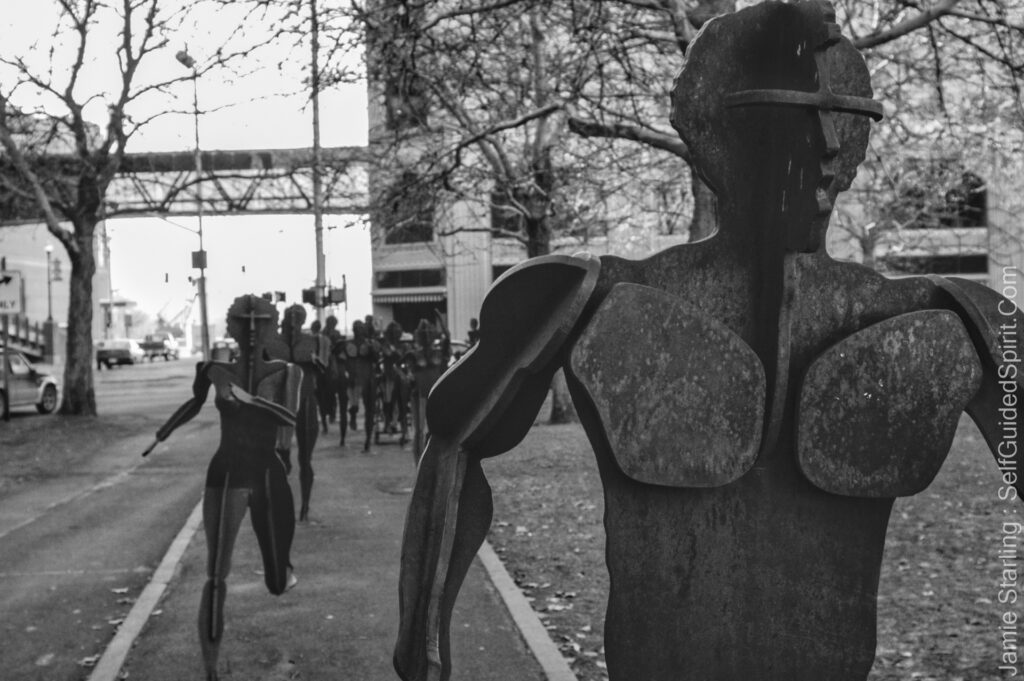
Running After
Received : 2005 February 2 – Spokane, Washington.
What has been taking too much of you?
Attention Is Where Your Life Is Being Spent
We usually talk about attention like it is a productivity issue. We say we need to focus more, scroll less, manage our time better, or stop getting distracted. There is truth in that, but it does not go deep enough.
Attention is not only about getting more done. Attention is about what is slowly becoming your life.
Where your attention goes, your energy follows. Where your energy goes, your habits form. Where your habits form, your life begins to take shape. This is why attention matters. Not because you need to become some perfectly disciplined person who never wastes a minute, but because your attention is one of the main ways you participate in your own becoming.
If you give the best of your mind to noise long enough, noise starts to feel normal. If you give your attention to comparison long enough, your own life starts to feel insufficient. If you keep feeding urgency, outrage, distraction, and stimulation, it becomes harder to hear the quieter things inside you that actually matter.
What you feed becomes louder.
The Pull of Brain Candy
And I get it. Sometimes we just want some brain candy. We want to watch a few shorts, scroll Facebook for a minute, play a game, check out, laugh at something, or let our mind go somewhere that does not ask much from us.
There is nothing wrong with needing rest. There is nothing wrong with entertainment. There is nothing wrong with enjoying something that gives the mind a break.
The problem is when a break quietly becomes a pattern, and the pattern quietly becomes a direction.
I have seen this in myself. I would watch a short or see something online and think, I am just going to look into this for a minute. Then one thing would lead to another. A video would lead to a search. A search would lead to another clip. A comment would lead to another thought. Before I knew it, an hour or more was gone.
It did not feel dramatic while it was happening. That is part of the danger. It never announced itself as a theft. It just took a little bit, then a little more, then a little more after that.
The same thing can happen with video games. I enjoy them. I am not going to pretend I do not. But there is a moment, especially with games that show you how many total hours you have played, where it starts to hit differently. You look at the number and realize that this was not just downtime. This was a piece of your life.
And then the harder question shows up: what could I have built with that same time?
The Cost Is Not Only Time
It is easy to say the cost of distraction is time, but that is only part of it. The deeper cost is energy. Direction. Inner momentum. The slow weakening of your ability to stay with something that matters.
An hour here and there may not seem like much. But attention compounds. So does avoidance. So does creation.
The time spent scrolling could have become a skill. The time spent drifting could have become a piece of writing, a photograph, a model, a project, a stronger body, a clearer mind, a better relationship with your own life. Not because every moment has to be productive, but because a life cannot be built from leftovers alone.
We all need downtime. We all need rest. We all need moments where nothing is being produced, measured, improved, or optimized. But there is a difference between rest that restores you and distraction that drains you while pretending to comfort you.
Rest gives something back.
Distraction usually asks for more.
What Owns Your Attention Owns Your Direction
This is why attention is an inner authority issue. If something can continually pull your attention, it can slowly shape your direction without your permission.
It can tell you what to care about. It can tell you what to fear. It can tell you what to compare yourself to. It can tell you what is urgent, what is desirable, what is missing, and what kind of life you should be chasing.
And if you are not paying attention to what is shaping you, you may mistake that influence for your own thoughts.
That is where the real danger is. Not the phone. Not the game. Not the app. Not the entertainment itself. The danger is unconscious surrender. The danger is giving your inner life away in small pieces and never stopping long enough to ask where it all went.
Your attention is your life, spent moment by moment.
That does not mean you need to live rigidly. It means you need to live awake.
Building Something of Your Own
At some point, we have to ask a better question than, “Is this bad?”
A better question is, “What is this building in me?”
That question changes everything. It moves the conversation away from guilt and toward responsibility. It stops making attention about rules and starts making it about direction.
What would happen if some of that energy went toward building something of your own? Not necessarily a business. Not necessarily something impressive. Maybe a model. A garden. A skill. A piece of writing. A body of work. A practice. A craft. A habit that makes your life better in the end.
Creation does something different to a person than consumption does. When you create, you participate. You make contact with your own agency. You remember that your life is not only something happening to you. It is something you are helping shape.
That is why this matters for Self Guided Spirit. It is not just about using time better. It is about returning to the part of yourself that can still choose, still notice, still build, still become.
Reclaiming Attention Without Turning It Into Performance
The answer is not to become harsh with yourself. Shame does not create freedom. It usually creates another cycle to escape from.
The answer is awareness. Start noticing what gets the best of you. Notice what you reach for when you are tired, uncertain, lonely, bored, restless, or avoiding the next honest thing. Notice what leaves you clearer and what leaves you scattered. Notice what restores you and what only numbs you.
Then make one honest adjustment.
Not a dramatic vow. Not a new identity. Not a performance of discipline. Just one choice that says: my attention matters. My energy matters. My life matters.
Put the phone down for a while. Turn the game off before the night disappears. Make the thing. Write the page. Take the walk. Pick up the camera. Practice the skill. Sit in the quiet long enough to hear what has been buried under the noise.
You do not have to reclaim your whole life in one day. But you do have to stop pretending that what you give yourself to does not shape you.
The Quiet Return
Your attention is not free. It is being spent every day, whether you choose consciously or not.
The question is not whether you will give your attention away. You will. We all do. The question is whether you are giving it to things that help you become more awake, more honest, more alive, and more responsible for your own path.
Because what owns your attention eventually influences your life. And what you keep returning to becomes part of who you are becoming.
So return carefully.
Return honestly.
Return to what gives your life back to you.
Closing Reflective Question
What noise is asking for too much of your life?